
The Deterioration of Human Rights in Shifting Global Power
- World Anti Extremism Network
- The Deterioration of Human Rights in Shifting Global Power
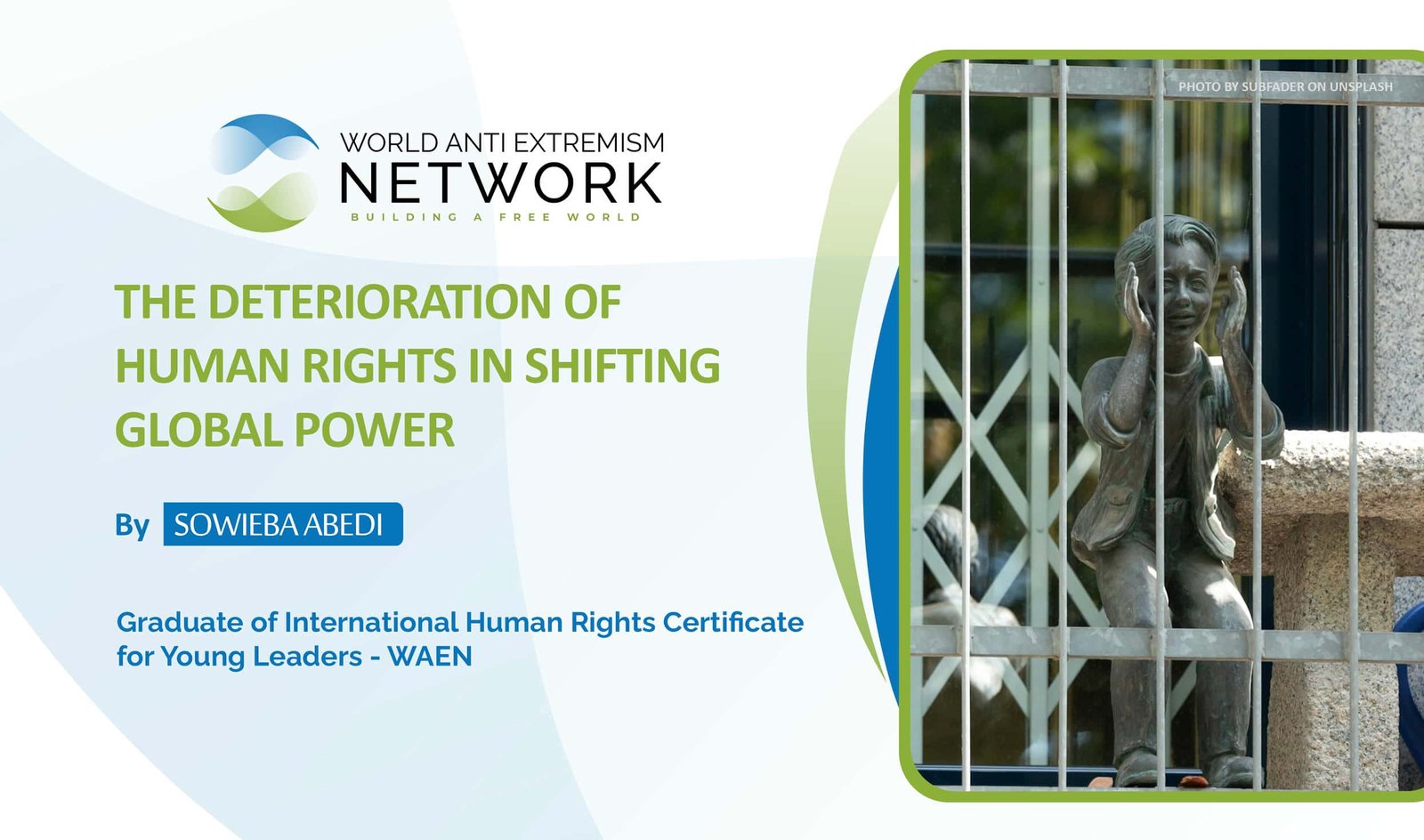
Human rights belong to the human beings without any distinction of race, color, language, religion, or thoughts. These human and intrinsic rights are one of the key reasons for the United Nations Foundation and are even viewed as a universal standard, as mentioned in the preamble of the UN Charter “to reaffirm faith in fundamental human rights, in the dignity and worth of the human person, and in the equal rights of men and women and of nations large and small”. In addition, these rights are emphasized in the UN Charter “to achieve international cooperation in solving international problems of an economic, social, cultural, or humanitarian character and in promoting and encouraging respect for human rights and for fundamental freedoms for all without distinction as to race, sex, language, or religion.”
However, over the past 77 years, these universally accepted rights have faced numerous challenges and threats due to the evolving global order. The shifting global order characterized by the rise of new geopolitical actors, the retreat of traditional powers from global leadership and the increasing influence of nationalism and populism, have contributed to a deterioration in the protection and promotion of human rights worldwide.
1. Factors Behind the Deterioration of Human Rights
The deterioration of human rights is influenced by a variety of factors, including both state and non-state actors.
1.1 Human Rights
Although the concept of human rights has an ancient root, their clear development took place after the atrocities of World War II. A new interpretation of human rights emerged, emphasizing the inviolability and dignity of every individual. This understanding was later enshrined in the UN Charter, becoming a core element of modern international system.[1]
Human rights are rights we possess simply by virtue of being human. These universal rights apply to all people, regardless of sex, ethnic origin, color, language, or other status.
The key characteristics of human rights are:
- Universal – they apply to everyone, everywhere
- Inalienable – they cannot be taken away
- Indivisible – no right is more important than another
- Interdependent and interrelated – all rights are connected and mutually reinforcing
1.2 shifting Global Order
The global landscape of power has undergone significant transformations over the last decade, shifting the dynamics of global influence and challenging traditional geopolitics frameworks. The dominance of Western powers, particularly the United States, has been a cornerstone of the international system since the end of World War II. T However, in today’s evolving global order, geopolitics conflicts and rivalries have become increasingly critical for policymakers and stakeholders to navigate. The global financial crisis of 2008 served as a turning point in accelerating the shift toward a more multipolar world. The rise of emerging economies like China and India has played a central role in these transformations.[2]
Major geopolitical events in the last four to five years, including the disastrous withdrawal of the United States from Afghanistan after two decades of military presence and the Taliban’s return to power on 15 August 2021, Russia’s military invasion of Ukraine on 22 Feb 2022, the 15-month bloody war between Israel and Hamas and their fragile ceasefire, and the weakening of Iran’s proxy forces in the Middle East, especially the fall of Assad’s regime in Syria, further the ongoing power shift. Moreover, issues such as technological advancement, economic influence, and environmental sustainability now play a central role in shaping the international system.
2. The Factors Behind Deterioration of Human Rights
The deterioration of human rights, despite the presence of a robust legal framework and rich historical background, remains a pressing issue of the current decade. Even in the 21st century, human rights abuses persist across many parts of the world. This continues despite the efforts of global humanitarian organizations, regional human rights mechanisms, and international bodies such as the Human Rights Council and International Criminal Court. Meanwhile, the ongoing shifting global order is the primary driver of this decline.
Globally, threats to international human rights today are numerous and complex. National security, economic, and diplomatic interests continue to pose significant challenge to adherence to human rights norms. Additionally, other treats like the impact of climate change on human rights, rapid growth of global inequality, and weakening international protections further complicate the situation. Importantly, threats to international human rights are emerging from three new directions: firstly, increasing geopolitical competition and power struggle that challenge human rights obligations under the banner of state sovereignty. Secondly, the rise of xenophobic and populist domestic movements, and thirdly, the spread of surveillance technologies.[3]
During the Cold War, the liberal West’s countered the communist bloc by emphasizing human rights norms and rules. However, Following the West’s victory, there has been a diminishing emphasis on international organizations and the rule of human rights. They have increasingly ignored international organizations and laws.[4]
Today, the world order is a critical juncture, transitioning toward a multipolar framework in which is dispersed among emerging economies, regional powers, and non-state actors, all of which influence the promotion and protection of human rights globally. This rebalancing of power is intensifying tensions and competition among major powers and while creating new opportunities for smaller states to assert themselves. Ongoing conflict in Europe, the Middle East, or South Asia exemplify these geopolitical tensions.[5]
Several key factors contribute to the global decline in human rights values.
2.1- Geopolitical Competition
The main factors driving the deterioration of human rights are geopolitical rivalries between global powers. In geopolitics, conflicts arise when states compete for influence, resources, and strategic positions often causing human rights values to take a backseat to national interests. A clear example of this ongoing geopolitical order is the dire situation in Afghanistan, Russia’s invention of Ukraine and tensions in Middle East, and China’s expanding global initiative.
Afghanistan and the dismal situation of human rights
Twenty years after the United States and NATO invaded Afghanistan, the sudden withdrawal and collapse of the Afghan government have definitively undercut the perceived reliability of Western commitment to stability and the defense of human rights in the region. The shift and apparent decline in the United States foreign commitment to human rights became evident when the Biden administration followed a plan to pull U.S. troops out of Afghanistan, leading to Taliban’s return. The U.S. departure has left behind thousands of Afghans who worked with the American and Western NGOs to promote human rights. This action almost trampled genuine political progress.[6]
- Russia’s special military operation or invention Russia’s assertive foreign policy challenges the western norms through actions such as the annexation of Crimea in 2024 and the use of military force to reclaim influence over its near abroad. by using its military force. The ongoing tension between the West and Russia’s “special military operation” in Ukraine has significantly shifted international legal and security order. As a result, countries like Finland and Sweden sought NATO membership.[7]
- China and Human Rights Abuse
China’s counterterrorism is used to justify repression of Xinjiang, that marks an entire ethnic group as security threats, in order to legitimize mass surveillance and forced detention. However, China’s genocide of Uighurs has faced limited international pushbacks due to economic interests of most countries with China. China’s ambitious Belt and Road Initiative seeks to enhance global trade connections through massive investment in infrastructure across Asia, Africa, and Europe. This positions China as a key player in shaping global economic and geopolitical dynamics. However, this initiative has been criticized for undermining human rights, as many African nations face pressure to compromise democratic values in exchange for economic aid and investment.[8]
Middle East Conflicts
A region historically characterized by instability and conflict is experiencing further deterioration of human rights amid shifting global order. The bloody 15-month war between Israel and Hamas, along with unwavering support for Israel by western countries has dealt a severe blow to human rights values and norms. Additionally, the collapse of Syria’s government on September 8, 2024, by Hayat Tahrir al-Sham; a group linked to Al-Qaeda, and the intensifying proxy conflict between Iran, Israel and even the United States have further destabilized the Middle East region, making the human rights landscape even more fragile and bleak.
2.3- Weakening of International Institutions
Human rights institutions; such as the United Nations, the European Union, and regional human rights courts, are designed to protect and uphold human rights. However, these insinuations have faced increasing challenges to their authority and effectiveness, particularly due to geopolitical tensions, budget constraints, and weakened the capacity to respond to human rights crises (Hurrell, 2015). The United Nations in particular, has faced criticism for its inability to effectively address the ongoing human rights crisis and gender discrimination in Afghanistan. Moreover, the withdrawal of some countries from international agreements and institutions has further undermined the global human rights framework.[9]
2.4- Growing Populism and Rise of Right-Wing Parties
Another significant driver of the erosion of human rights is the rise of exclusionary populism across the globe, from the U.S. and Brazil to Eastern Europe. The growing strength populist movements has weakened previously established democracies that once provide key support to international human rights. In addition, the rise of far-right parties across Europe has shaped these countries’ international commitments to protecting the rights of asylum seekers, for example refugees in Denmark being sent to Damascus by the country’s immigration office or the United Kingdom planning to send refugees to Rwanda.[10]
3. Recommendation and Conclusion
As the world navigates a rapidly shifting power structure, the need to reinforce human rights institutions and norms has never been more urgent. The challenge is not only to protect these rights amid geopolitical rivalries and growing authoritarianism but to reimagine a global system that places human dignity at its core. To mitigate the adverse impacts of the shifting global powers, states and human rights insinuations should consider the following points:
- Supporting local human rights organizations and civil society groups, particularly in underdeveloped countries.
- State and international human rights institutions must work closely and prioritize collaboration over isolation.
- Enhance the capacity of international human rights institutions through greater financial support.
[1] Griffiths, Martin, (2012). Encyclopedia of International Relations. P, 447.
[2] P. Kumar& Dahiya, Global Power Shift; Understanding the changing world order, Jornal of Visual and performing Art 5, no.1. 2024.
[3] Christopher Sabatini, ed.,” Reclaiming Human Rights in a Changing World Order”, Brookings Institution Press, 2023. Part II.
Dynamics Global Power Politics in 2024”, SETA, Opinion, January 10, 2024.
[4] Natasha Hall, “Breaking Point: Human Right in a Multipolar World,” CSIS, November 2023. [4] Muhittin Ataman, “Shifting Dynamics Global Power Politics in 2024”, SETA, Opinion, January 10, 2024.
[5] Natasha Hall, “Breaking Point: Human Right in a Multipolar World,” CSIS, November 2023.
[6] Sabatini, Reclaiming Human Rights, esp. part II.
[7] Sabatini, Reclaiming Human Rights, esp. part III.
[8] P. Kumar & Dahiya, Global Power Shift; Understanding the changing world order, Journal of Visual and performing Art 5, no. 1 2024.
[9] Andrew Hurrel, “Global Inequality and International Institutions, Metaphilosophy, No 32. 34-57, 2001.
[10] Sabatini, Reclaiming Human Rights, esp. part II.
The opinions expressed in these articles are solely those of the authors and do not reflect the views or positions of the organization. If you find any information incorrect, please contact (research@worldantiextremism.org), and we would be happy to assist you. You can download, distribute, and reuse this work, provided you credit the author and cite the original source.
Related Articles
Subscribe to our newsletter and stay updated.
Contact
Toronto, Ontario, M1L 0E5 Canada
Subscribe to our newsletter and stay updated.
Contact
Toronto, Ontario, M1L 0E5 Canada
Subscribe to our newsletter and stay updated.
Contact
Toronto, Ontario, M1L 0E5 Canada