

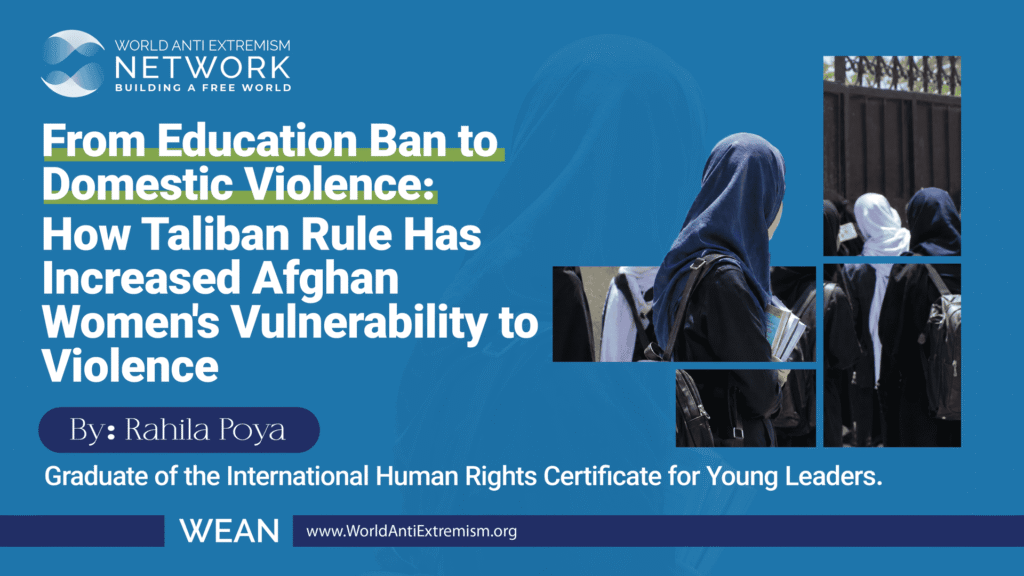
The return of the Taliban on 15 August 2021 has not only restricted and prohibited Afghan women and girls from exercising their basic human rights, but has also created a system where domestic violence is normalized, even in the capital of Afghanistan, Kabul City, where most of the population is educated. In many families, wives and daughters are treated as if they are nothing. The regime has not just changed laws, it has changed the way people think and behave towards their wives and daughters.
Nearly five years have passed, and what was first announced as a temporary measure has hardened into a permanent system. A generation of Afghan girls is growing up behind closed doors, watching their brothers leave for school each morning while they stay home to cook and clean. Women who once worked as teachers, doctors, judges, journalists, and civil servants now sit at home, dependent on male relatives for every meal. This article is about what that loss looks like from the inside—about how a ban on education becomes a permission slip for violence, and about what Afghan women are doing, quietly and at great risk, to resist it.
The Taliban’s Record on Women
Under their first rule in the 1990s, the Taliban banned girls from going to school and women from working, completely taking away their freedom and access to education. Today, they are repeating the same strategy and pattern. According to UNESCO, around 2.2 million Afghan girls have been denied access to secondary schools and universities. Afghanistan is now the only country in the world where girls are systematically barred from education beyond primary school, which is a devastating reality.
The method has been deliberate, step by step. In September 2021, when secondary schools reopened for boys, girls were told to stay home until further notice. In December 2022, universities were closed to women, and days later, women were barred from working for national and international non-governmental organizations. In 2023, that order was extended even to Afghan women employed by the United Nations. Beauty salons, one of the last women-only spaces and sources of female income, were ordered to close. Women have been pushed out of parks, gyms, and other public spaces, and cannot travel long distances without a mahram, a male guardian. The Ministry of Women’s Affairs was dissolved and replaced by the Ministry for the Propagation of Virtue and Prevention of Vice, whose inspectors now patrol the streets.
According to the International Labour Organization (ILO), women’s employment in Afghanistan has declined by approximately 25% since the Taliban returned to power in August 2021. Many female public sector employees who were barred from returning to work were placed on a fixed monthly payment of 5,000 Afghanis in 2024. Reports from January 2026 indicate that these payments were discontinued for many of these women, leaving thousands without an income.
Behind every one of these figures stands a household pushed deeper into poverty. Many Afghan women were the sole breadwinners of their families: widows, divorced women, and wives of men who are disabled, ill, or unemployed. When their salaries disappeared, so did their children’s school fees, their medicine, and their food. A woman who cannot feed herself cannot bargain. She cannot refuse a marriage arranged for her daughter, cannot leave a violent husband, and cannot pay a lawyer even if one were allowed to help her. Economic dependence is not a side effect of the bans, it is their purpose.
From Education Ban to Domestic Violence
When you take away a woman’s education, you take away her ability to earn, to speak up, and to leave. The Taliban know this. That is why the ban is not just about schools, it is about control.
Afghanistan once had systems in place to protect women. For example, In 2009, the country adopted the Law on the Elimination of Violence Against Women (EVAW), which criminalized rape, forced marriage, and serious beatings, and created special prosecution units to handle such cases. A network of shelters gave survivors somewhere to run and now all of that has been dismantled. The shelters were closed, and some of the women who lived in them were sent back to the very relatives and husbands they had fled. Female judges, prosecutors, and lawyers were removed from their posts, while the legal system and judicial independence in Afghanistan suffered a profound collapse. A woman who reports abuse today may face significant barriers to justice and increasingly turn to informal mediation by religious leaders, community elders, or family, all of which remain largely male-dominated and whose standard solution is to order her back to her husband and tell her to be a better wife. In January 2026, the Taliban endorsed a new criminal regulation that has been widely criticized by the United Nations and human rights organizations for weakening legal protections against domestic violence. Under the regulation, a husband who causes a visible bruising to his wife may face up to 15 days’ imprisonment if the case is proven before a judge. By comparison, organizing animal or bird fights is punishable by up to five months in prison. Human rights organizations argue that these provisions institutionalize discrimination against women and reflect the unequal legal protection afforded to women under the regulation. The same regulation criminalizes women who try to escape. If a wife runs to her parents’ home to get away from abuse, she gets three months in prison. Her family gets three months too. The message is simple: stay and suffer.
The consequences reach far beyond any courtroom. There has been a rise in forced and early marriages, as desperate families marry off daughters they can no longer educate or feed. Health workers describe women arriving at clinics with untreated injuries and nowhere safe to go afterward. Children who grow up watching their mothers being beaten learn the lesson the regime intends: that this is simply how life is. When a girl sees that her mother has not received any formal education, has no job, no money, no shelter, and no court to turn to, she understands that her own future is meant to look the same.
The Regime’s Effect on Mindset
The Taliban are not just ruling, they are teaching. Through public floggings and executions, they show that violence is order. By removing books by women from stores and banning human rights education, they erase any idea that women are equal. In Taliban schools, boys learn that they are born to rule their households. Girls learn only to obey.
This teaching is now written into law. The virtue and vice law published in 2024 restricts women’s voices, dress, and movement in public, treating a woman’s very presence outside the home as something to be controlled. In public, women’s voices have increasingly been restricted, with the Taliban’s new laws prohibiting women from singing, reciting, or reading aloud. Textbooks have been rewritten, Friday sermons repeat the same message week after week, and no voice on state media is allowed to contradict it. A boy who is twelve years old today has spent most of his conscious life under Taliban rule. He has never seen a woman judge a case, present the news, or teach a university class. What we are witnessing is the deliberate engineering of a society in which half the population has no visible existence.
This has changed how families behave. In Kabul, even in relatively educated households, many men now treat their wives and daughters as property. A father who once supported his daughter’s education now sees her only as a burden to marry off. A husband who once respected his wife now believes he has a religious right to beat her. The regime has made cruelty look like virtue.
This normalization is the regime’s deepest victory, and it is exactly why the education ban matters so much. An educated mother is the first protection a daughter has. Take away her mother’s education and her job, and that protection disappears with them. Violence then reproduces itself, from father to son and from mother-in-law to daughter-in-law, until it no longer looks like violence at all, only tradition. Breaking this cycle requires more than statements of concern from abroad; it requires reaching women where they actually live.
Recommendations
In Kabul, where women and girls face significant economic and social challenges, community-based learning and empowerment initiatives can provide women and girls with safe opportunities to continue learning, develop practical skills, and strengthen their resilience.
The women and girls who could benefit from such programs include former schoolgirls and university students whose classrooms were shut down, teachers who lost their jobs, and young mothers who were never allowed to complete their education. Because formal gatherings can attract unwanted attention, these activities can be organized quietly in small groups and home-based spaces, with schedules shared only with participants. Everything should be built on trust within the community, allowing women to participate without putting themselves or their families at risk.
Such programs can combine vocational skills such as tailoring with basic non-formal education, life skills, awareness sessions, and psychosocial support. The aim is to help women and girls remain engaged, build confidence, and maintain hope despite the current restrictions on formal education.
Each part of such a program serves the same goal: a woman’s independence. Tailoring and other vocational skills allow her to earn an income from inside her home, which is often the only work a family will permit, and even a small income can change how she is treated. Basic literacy and numeracy let her read a medicine label, keep accounts, and understand a document before she signs it. Awareness sessions give her words for what is happening to her, and psychosocial support reminds her that she is not alone. Over time, participants can also be supported to become trainers themselves, allowing knowledge to pass from house to house.
The sessions can focus on preventing domestic violence by raising awareness among women and mothers about supportive family relationships, how to protect their daughters, how to recognize risks, and how to seek safe support when needed. All activities should be designed with sensitivity to the current context to avoid creating additional risks for participants.
Lasting change must involve the whole family. Wherever it can be done safely, community-based sessions can include mothers and, in some cases, male relatives, because a husband or father who understands the cost of violence can play an important role in protecting women and girls. Participants should also help shape the activities themselves, and nothing—no signboard, no public announcement, no written record—should be allowed to create risk for them. In today’s Afghanistan, safety is not a detail of program design. It is the program.
For these initiatives to continue, financial support is needed for training materials, equipment, safe learning spaces, trainers, and awareness activities. Supporting community-based programs can help women and girls develop skills, strengthen resilience, and continue contributing positively to their families and communities. The international community should consider directing greater support toward grassroots work.
The needs are modest and concrete: sewing machines and fabric, books and stationery, a stipend for a trainer, rent for a safe room, and transport for a participant who lives far away. Such support does not necessarily require a large agency or a foreign office. Yet too much of the international response to Afghanistan’s crisis stops at conferences, statements, and reports, while community initiatives like this one struggle to survive from month to month. Funding that reaches women directly through trusted local networks can help keep learning alive and strengthen women’s ability to cope with restrictions, economic hardship, and violence.
Conclusion
The restrictions imposed on Afghan women have consequences that extend far beyond the loss of education and employment. As women lose economic independence, legal protection, and access to safe spaces, their ability to resist abuse and seek support becomes increasingly limited. The result is not only greater vulnerability to violence, but also a growing risk that inequality and harmful attitudes will be passed from one generation to the next.
Yet Afghan women continue to find ways to learn, support one another, and protect their hopes for a different future. Their resilience shows that even under severe restrictions, the desire for education, dignity, and independence cannot simply be erased. What is needed now is sustained attention and meaningful support for the women and communities working to preserve these opportunities.
The world has tools, if it chooses to use them: sustained funding for community education, support for women-led organizations inside Afghanistan, and continued attention to the rights and safety of Afghan women. Afghan women are not asking the world to save them. They are asking it not to look away while they save themselves. They deserve more than survival. They deserve dignity, freedom, and a future.