

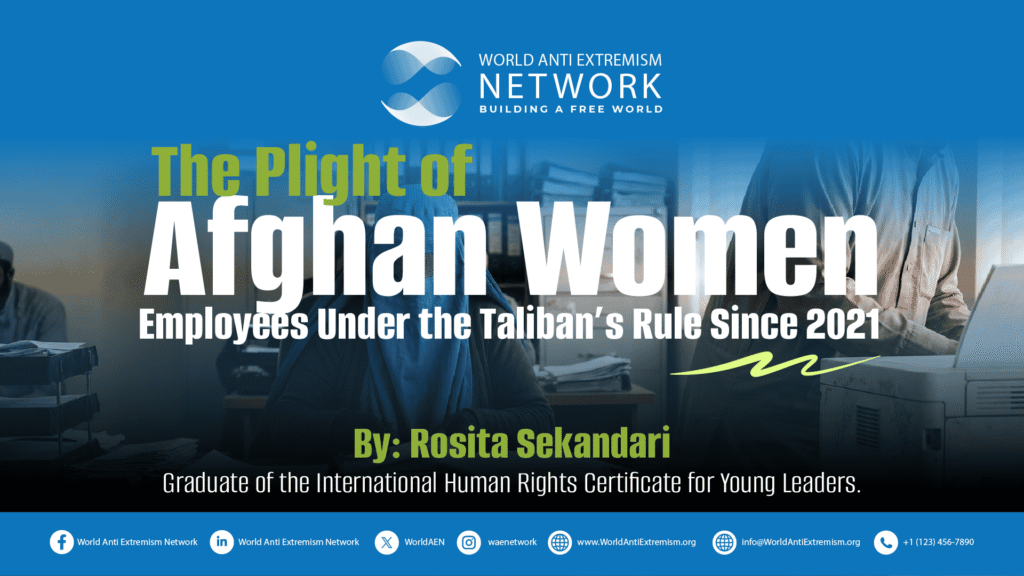
August 2021 marked a turning point in Afghanistan’s history. Following the Taliban’s return to power, Afghan women faced increasing restrictions on their participation in public life, including severe limitations on employment. This essay argues that the Taliban’s restrictions on women’s employment constitute a serious violation of fundamental human rights, particularly the rights to work, equality, and non-discrimination. By preventing women from working in NGOs, United Nations agencies, and parts of the public sector, the Taliban have reinforced gender-based discrimination and further marginalized women from public life.
To support this argument, the essay examines how the ban on women’s employment was implemented and explores the factors that have shaped the Taliban’s policy toward female workers. It then considers an important question: do all women face restrictions on employment, or are certain groups permitted to continue working? By analyzing the limited exemptions to the ban and their implementation across different sectors, the essay assesses the extent to which women remain able to participate in public life. Finally, it evaluates the human rights consequences of these restrictions and considers their broader long-term implications for Afghan women and Afghan society.
Development and Enforcement of Employment Restrictions
According to an Al Jazeera report published on 24 December 2022, the Ministry of Economy ordered all local and international NGOs to stop female employees from coming to work until further notice. Any NGO found not complying with the order would have its operating licence revoked in Afghanistan. It was not immediately clear how the order would affect United Nations agencies. The directive applied to organisations under Afghanistan’s coordinating body for humanitarian organisations, known as ACBAR, which includes more than 180 local and international NGOs but does not include the UN. Following the Taliban’s directive restricting women from working in non-governmental organisations, United Nations agencies reported that several humanitarian programmes were temporarily suspended due to a shortage of female staff, despite more than 28 million people in Afghanistan requiring urgent humanitarian assistance amid economic collapse and harsh winter conditions. The UN stressed that female humanitarian workers are essential because they enable access to women beneficiaries who cannot be reached by male staff. Women’s work across various sectors, including roles supported by national and international organisations, generates over $1 billion annually in household income across Afghanistan. UN Women Executive Director Sima Bahous reported that 11.6 million women and girls have been deprived of vital assistance as a result of the restrictions, with women-headed households (around one quarter of households in Afghanistan) losing access to livelihood support.
Justifications and Ideological Motivations Behind the Ban
As fear and uncertainty grow due to the Taliban’s edicts, the pressing question remains: why is the Taliban so opposed to women working in NGOs and international organizations? The Taliban’s restrictions on women’s employment are rooted in a broader ideological and theological framework that views women’s public presence as a moral and social threat. As outlined in their manifesto “The Islamic Emirate and Its System” by Abdul Hakim Haqqani, the Taliban argue that women’s primary role is within the household and that interaction with unrelated men creates moral danger, reflecting a strict interpretation of Sharia that confines women to domestic spaces. This worldview is reinforced by concepts such as fitna, which portrays women as potential sources of temptation and social disorder, thereby justifying their exclusion from public and professional life and contributing to what scholars describe as “gender apartheid.” Institutionally, these beliefs have been operationalised through the replacement of the Ministry of Women’s Affairs with the Ministry for the Propagation of Virtue and Prevention of Vice, which actively enforces moral regulations and monitors women’s behaviour in public life.
In addition to theological reasoning, the Taliban’s gender ideology is shaped by cultural and social structures linked to Pashtunwali and rural Pashtun communities, where women are often regarded as custodians of male honour and are expected to remain within domestic boundaries. Journalist Sami Yusuf argues that many Taliban leaders were raised in rural, tribal environments with limited exposure to female education or employment, which has reinforced conservative attitudes toward women’s roles in society. Furthermore, the Taliban’s interpretation of Islam is influenced by Deobandi madrassa education, which promotes a puritanical worldview. This ideological framework is reflected in policies that restrict women’s work and visibility in society, including bans justified on the grounds of dress code violations such as non-compliance with hijab requirements. Overall, these intersecting religious, cultural, and educational influences form the basis of the Taliban’s justification for restricting women’s employment and public participation.
Implementation Gaps and Sectoral Impact of Employment Restrictions
An important question remains whether these restrictions are applied uniformly across all sectors. The Taliban’s restrictions on women’s employment have not been implemented as a uniform or fully consistent policy across sectors. According to the International Crisis Group, while the ban broadly prohibits women from working in most non-governmental organisations, authorities clarified that women remain permitted to work in parts of the health sector, including hospitals and clinics, where female staff are considered essential for service delivery. Similarly, another source highlights that limited flexibility has been observed in specific programmes such as health, nutrition, and primary education, where female participation has occasionally been allowed despite broader restrictions. However, in practice, implementation has been highly uneven and unstable. A UN Women survey of 151 NGOs reported that only 15% of organisations were fully operational shortly after the ban, with all organisations noting a reduced ability to reach women beneficiaries. Although some programmes resumed under exemptions in sectors such as health and education, these permissions have often been conditional, inconsistently communicated, and in some cases not formally documented, creating significant uncertainty for organisations and staff. In several cases, NGOs have reported reluctance to disclose exemption arrangements due to fears that increased visibility could result in further restrictions or suspension of operations.
Human Rights and Socioeconomic Consequences of the Restrictions
Women constitute approximately 30% of Afghanistan’s NGO workforce, making them a critical component of the humanitarian system. Beyond the humanitarian sector, women in public-sector employment were also affected. Prior to the Taliban takeover, women constituted nearly one-third of Kabul municipality’s workforce and worked across all departments; however, many female public employees were later instructed to remain at home. This reflects a broader pattern of exclusion, as the Taliban’s restrictions have resulted in widespread marginalization of women from both public and professional life, leading to severe human rights and socioeconomic consequences. In addition to prohibiting women from legal and judicial professions, including lawyers and judges, an estimated 4,000 women who previously served in the military under the former government have been rendered unemployed, while many female judges have reportedly fled or gone into hiding due to security threats. Similarly, restrictions on media participation have been extensive, with women banned from state media and facing strict limitations in private outlets, including mandatory face coverings and gender-segregated workplaces, contributing to an estimated 80% loss of women journalists’ employment.
Beyond formal employment sectors, restrictions have also extended into mobility and daily life. Reports indicate that women are prohibited from travelling long distances without a male guardian, significantly limiting their independence and access to services. In the private sector, although female entrepreneurship has occasionally been publicly supported through symbolic initiatives, women continue to face structural barriers, including restricted access to suppliers and enforced workplace segregation. The closure of beauty salons in 2023 alone resulted in approximately 60,000 women losing their livelihoods, illustrating the direct economic impact of regulatory decisions. In 2022, UNDP estimated that restrictions on women’s employment could reduce Afghanistan’s GDP by up to $1 billion annually, equivalent to around 5% of GDP. Additionally, Taliban enforcement mechanisms, including workplace inspections and punitive actions against women found working without authorization, further reinforce exclusionary practices.
The Taliban’s restrictions on women’s employment also violate internationally recognized human rights standards. Article 23 of the Universal Declaration of Human Rights affirms that everyone has the right to work, to free choice of employment, and to protection against unemployment. By systematically excluding women from employment opportunities on the basis of gender, the Taliban undermine this fundamental right and deny women equal participation in economic and public life. Furthermore, the Convention on the Elimination of All Forms of Discrimination against Women (CEDAW) obliges states to eliminate discrimination against women in employment and to ensure equal opportunities in the workforce. Although the Taliban are not internationally recognized as a government by most states, their policies have created conditions that directly contradict the principles of equality, non-discrimination, and women’s economic empowerment enshrined in international human rights law. These violations demonstrate that the employment restrictions are not merely administrative measures but form part of a broader system of gender-based exclusion that has reshaped Afghan women’s role in society.
Recommendations
To address the systematic exclusion of Afghan women from employment and public life, the following measures should be prioritized.
First, the Taliban authorities should immediately revoke restrictions preventing women from working in NGOs, international organisations, and other sectors where they have traditionally played essential roles. Restoring women’s access to employment would not only uphold fundamental human rights but also strengthen humanitarian service delivery and economic recovery.
Second, international organizations and donor governments should continue documenting and monitoring violations of women’s rights in Afghanistan while maintaining diplomatic engagement aimed at securing measurable improvements in women’s participation in public life. Any formal cooperation with Taliban authorities should prioritize clear benchmarks related to women’s employment, education, and freedom of movement.
Third, humanitarian agencies should expand support for women-led livelihood initiatives, remote work opportunities, and community-based employment programs where security and operational conditions permit. Such initiatives can help mitigate the economic hardship faced by women who have lost access to formal employment.
Fourth, international donors should increase financial and technical support for Afghan women entrepreneurs, particularly those operating small businesses and home-based enterprises. Providing access to training, markets, and financial resources can help women maintain a degree of economic independence despite existing restrictions.
Finally, greater support should be provided to Afghan women human rights defenders, journalists, lawyers, and former public servants who have been disproportionately affected by employment bans and security threats. Protecting these groups is essential for preserving civic space and promoting long-term gender equality in Afghanistan.
Conclusion
The Taliban’s restrictions on women’s employment represent a serious violation of the rights to work, equality, and non-discrimination. As this essay has shown, these restrictions are rooted in ideological beliefs that seek to limit women’s participation in public life and have been implemented across multiple sectors, particularly NGOs and humanitarian organizations. Although limited exemptions exist in areas such as health care, the overall policy framework has systematically excluded women from economic and professional opportunities.
The consequences extend beyond individual women, affecting humanitarian service delivery, household incomes, and Afghanistan’s broader economic development. By restricting women’s ability to work, the Taliban have not only undermined fundamental human rights but have also weakened the country’s capacity to address ongoing social and economic challenges. Ensuring women’s full participation in the workforce is therefore both a human rights imperative and a prerequisite for Afghanistan’s long-term stability and development.