

After gaining independence, Burundi has experienced recurring crises marked by political instability, ethnic conflict, and violence. The most devastating episodes occurred in 1972 and 1993, with the latter triggered by the assassination of the country’s first democratically elected president, Melchior Ndadaye. Following this crisis, the National Council for the Defense of Democracy–Forces for the Defense of Democracy (CNDD-FDD) emerged as a rebel movement and later became Burundi’s ruling party.
While the CNDD-FDD presented itself as a movement fighting against historical injustice and political exclusion, serious concerns regarding human rights conditions in Burundi continue to be raised. According to reports published by the Burundi Human Rights Coalition between 2023 and 2025, violations including torture, enforced disappearances, extrajudicial killings, and arbitrary arrests continue to be documented under CNDD-FDD rule. This article examines key human rights concerns in Burundi, including restrictions on media freedom, abuses allegedly linked to the Imbonerakure, pressure on human rights defenders, and challenges related to accountability.
Restrictions on Media Freedom and Freedom of Expression
Since the failed coup attempt in 2015, many independent media outlets have been suspended, destroyed, or forced into exile, while numerous journalists have fled the country. Human Rights Watch documented the repression of media and civil society in Burundi through a chronology covering key events from April 2015 to June 2020. According to Reporters Without Borders (RSF), although President Évariste Ndayishimiye pledged to improve relations with the media after taking office in 2020, journalists in Burundi continue to face significant challenges. Many of these difficulties stem from the 2015 political crisis, which led to the censorship, destruction, or exile of several independent media outlets and continues to affect freedom of expression.
The ruling party CNDD-FDD maintains considerable influence over the flow of information, particularly through the National Communication Council (CNC). In certain provinces, journalists reportedly face restrictions on their reporting activities, including requirements to obtain official authorization or to work alongside state media journalists when covering particular issues. Journalists also face the risk of arrest, physical attacks, and legal prosecution. This situation fosters a climate of fear that severely restricts media independence and weakens press pluralism in Burundi.
The most well-known case illustrating the threat against journalists in Burundi is the disappearance of journalist Jean Bigirimana in July 2016 after he was allegedly taken into the custody of the National Security Service (SNR). To date, his whereabouts remain unknown. This case exemplifies the risks faced by journalists and contributes to a broader climate of intimidation and self-censorship. This violence against journalists is not isolated. Three years later after the disappearance of that journalist, four journalists from the independent newspaper Iwacu, Christine Kamikazi, Agnès Ndirubusa, Térence Mpozenzi and Egide Harerimana, were arrested while reporting on clashes in the former Bubanza Province, although they were later released following international advocacy efforts.
Militarization and Impunity of the Ruling Party’s Youth Wing: The Imbonerakure
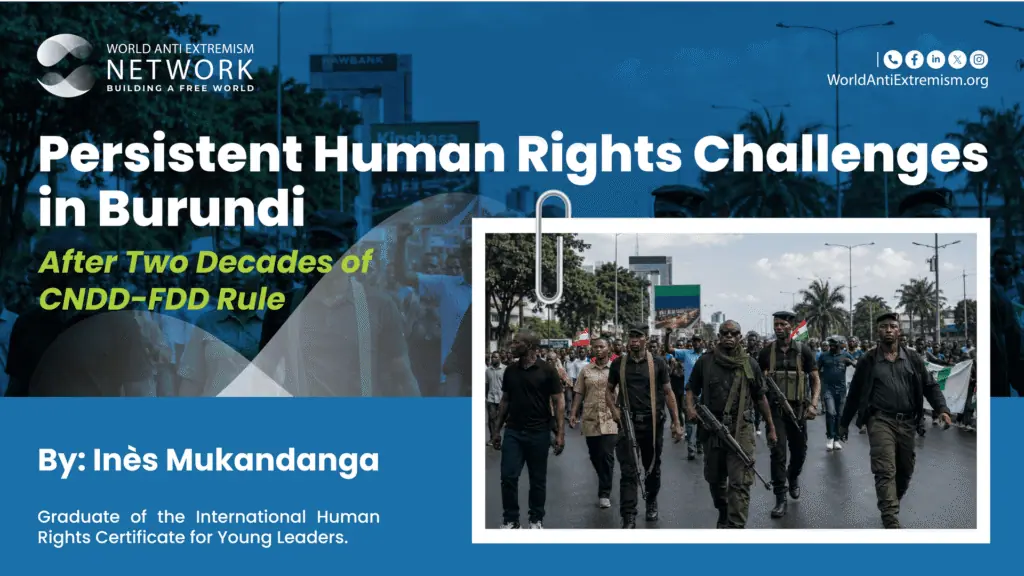
Report from the UN Special Rapporteur on Burundi indicate a continuing militarization of the Imbonerakure, the youth wing of the ruling CNDD-FDD party. In 2025, members reportedly received paramilitary training in Cibitoke province, and recruitment drives were documented in several parts of the country, with recruits transferred to military training camps. These developments have intensified concerns that the Imbonerakure are increasingly operating as a partisan security force rather than merely a political youth movement. Human Rights Watch has also documented allegations that members of the Imbonerakure have been involved in intimidation, harassment, arbitrary detention, torture, and killings targeting perceived political opponents, often acting alongside state security forces.
These concerns are echoed by United Nations human rights experts, who reported that between January 2024 and May 2025, civil society groups recorded at least 200 cases of sexual violence, including incidents involving children, 58 enforced disappearances, 62 cases of torture, 892 arbitrary arrests, and 605 extrajudicial killings.
According to a report by Swiss Refugee Council, evidence suggests that violent activities committed by members of the Imbonerakure have continued in certain areas. The group has been described as operating with widespread impunity, allowing members to commit abuses with little or no accountability. Present across the country, the Imbonerakure frequently act as an auxiliary force to the police, intelligence services, and local administrations, particularly in rural areas where they sometimes supplement or replace official security structures. The increasing role of the Imbonerakure in security-related activities erodes institutional neutrality and contributes to an atmosphere of intimidation and political coercion. They have also been widely reported to monitor, harass, and intimidate real or perceived political opponents by gathering information and helping enforce the ruling party’s influence over local populations.
Property Expropriation and Land Rights Concerns
Civil society organizations have accused certain government authorities of abusing their powers through unlawful or abusive land expropriations, often without adequate compensation or adherence to legal procedures. SOS Media says that in the former Province of Cibitoke, 100 families were expropriated from their lands by provincial administration. This case is not an isolated incident but reflects broader concerns regarding the protection of property rights in Burundi.
The most high-profile case is the Kira Hospital dispute, involving one of Burundi’s leading private healthcare facilities. The controversy emerged after the arrest and detention of Dr. Christophe Sahabo, the hospital’s promoter and former director, in April 2022. The case has drawn international attention because the hospital includes foreign investors, including Swiss, German, and British shareholders. The dispute has raised concerns about judicial independence, investor protection, and alleged expropriation through legal processes.
For Antoine Kaburahe, founder of the Iwacu Press Group and elected member of RSF in 2021, the Christophe Sahabo case is first and foremost ethnicized. Portrayed as an “extremist” who only recruits Tutsis, an ethnic group that is accused of genocide against Hutus ethnic group leading Burundi now. However, statistics revealed by Kaburahe challenge this narrative: “On the board of directors, 83% of the members are Burundian Hutu, in the management team, 5 out of 7 positions are also held by Hutu and the paramedical staff is 51% Hutu. In short, sometimes near parity, sometimes a clear Hutu majority, except at two levels: specialist and general practitioners, where Tutsis are in the majority. Historical reasons explain this disproportion, which therefore cannot be attributed to Dr. Sahabo”, wrote Kaburahe.
While the government has maintained that the case against Dr. Christophe Sahabo concerns allegations of fraud and mismanagement, the majority private shareholders and Swiss investors have disputed this narrative. As reported by SOS Médias Burundi, they argue that the arrests, forced resignations, and subsequent management changes formed part of what they describe as an irregular expropriation that deprived them of control over Kira Hospital. Similar concerns have been raised by some human rights defenders and civil society actors, who question whether the proceedings were used to facilitate a transfer of control of the hospital.
Beyond the expropriation of Christophe Sahabo, Kaburahe and Forum for Conscience and Development (FOCODE), a Burundian organization that works on issues related to governance, human rights, and development allege that the doctor was subjected to torture, including the use of a red-hot metal rod, in an attempt to force him to give up control of the hospital’s management. In Les carnets de Kaburahe, the well-known journalist raises a series of questions that highlight the unresolved aspects of the Sahabo case, while arguing that the government’s primary objective is to take control of Kira Hospital. If substantiated, these allegations would represent serious violations of the rights to physical integrity, due process, and protection from torture and arbitrary deprivation of property.
Surveillance of Dissidents and Civil Society
For several years, human rights defenders have stated that Burundian authorities continue to pursue them beyond the country’s borders, including in the countries where they have sought exile. According to these actors, this pressure has taken various forms, ranging from threats and intimidation to targeted surveillance, creating a persistent climate of fear.
In a recent interview broadcasted on the YouTube channel MAIN SWITCH 257, the Burundian ambassador to Brussels, Thérence Ntahiraja, stated that certain individuals are closely monitored, referring in particular to human rights defenders, civil society activists, political actors and journalists. These remarks have reinforced concerns regarding transnational repression and the surveillance of critical voices beyond Burundi’s borders. While these remarks come amid ongoing concerns about pressure on critical voices, Belgian authorities have reportedly been aware of claims that Burundian dissidents and activists abroad are being monitored.
According to RPA, an online news outlet, the 2024 report of the Office of the Commissioner General for Refugees and Stateless Persons, it was stated that the Burundi National Intelligence Service was monitoring the Burundian diaspora through its branches in Belgium, in order to identify possible external threats, through the Embassy of Burundi in Brussels, headed by Thérence Ntahiraja since August 2019. After the statements of the Burundian ambassador to Brussels, Thérence Ntahiraja, Belgian news outlet Knack reported that Belgian Foreign Minister Maxime Prévot has requested clarifications.
Extremist Rhetoric and Calls for Sexual Violence Against Women
Some members of the Imbonerakure have made inflammatory statements that have been interpreted by observers as encouraging violence or confrontation. Unfortunately, this militia continues to commit crimes with the alleged complicity of the Burundian authorities. According to UN News, speaking to the United Nations Human Rights Council, the UN Special Rapporteur on Burundi denounced the continued tolerance of human rights abuses, perpetrated by the Imbonerakure, the youth movement affiliated with the ruling party, as well as by the police and the National Intelligence Service.
Reported by rtbf, former UN High Commissioner for Human Rights Zeid Ra’ad Al Hussein has denounced the increasing number of incidents in which the Imbonerakure, the youth league of the ruling party in Burundi, called for the rape of female opponents. According to him, the shocking slogans calling for rape, had been repeated by young men belonging to the Imbonerakure in several provinces of Burundi. Calls for sexual violence against women because of their political affiliations represent an extreme form of gender-based political intimidation that threatens women’s security and undermines their equal participation in public and political life.
Recommendations
To ensure human rights in Burundi, several immediate decisions must be taken by different actors.
At the level of the government, which is the primary actor responsible for respecting human rights, it must punish all perpetrators of crimes, including members of the Imbonerakure, intelligence service agents, and security and law enforcement personnel, who are often accused of repressing political opponents.
Civil society actors, journalists, and human rights defenders must continue to denounce human rights abuses. However, these individuals must be financially supported in order to carry out their work effectively. Moreover, in a country where human rights violations have become commonplace, they must benefit from appropriate protection so that they can carry out their work safely.
The international community should closely monitor developments in Burundi to ensure that it does not continue receiving weapons and financial support that could be used against its own population. In addition, they must hold perpetrators accountable through international jurisdictions empowered to do so, because within the country, the justice system is allegedly manipulated for political purposes.
Conclusion
Two decades after the CNDD-FDD came to power, Burundi continues to face significant human rights challenges. Reports of restrictions on media freedom, abuses allegedly committed by members of the Imbonerakure, pressure on journalists and human rights defenders, concerns over property rights, and allegations of transnational surveillance point to persistent weaknesses in accountability and the protection of fundamental freedoms. Addressing these challenges requires credible investigations into human rights violations, greater respect for civil and political rights, and stronger safeguards for independent media and civil society. A peaceful and inclusive Burundi can only be achieved when all citizens, regardless of their political views or identity, are guaranteed equal protection under the law and can participate freely in public life without fear of intimidation or repression.