

While the changing of the climate is a natural phenomenon, the anthropogenic causes of the climate crisis that we are now facing are brought about by global warming that has not been seen by the world before. Greenhouse gases, such as carbon dioxide, nitrous oxide, and methane, have been at their highest levels in thousands of years. These gases serve as blankets that prevent heat on Earth from escaping. This heat is redirected back to Earth, especially the oceans, causing rapid increases in evaporation, glacier melt, and sea-level rise, among other effects. Limiting the cutting down of trees is an effective way to sequester carbon dioxide, which roughly comprises 75% of all manmade greenhouse gases, because trees absorb carbon dioxide and transform it into sugar to nourish themselves through photosynthesis. If we already know this truth, what prevents us from putting an end to human-caused climate change?
When we think that we are living the best life we can dream of, our self-absorbed thinking pushes almost all important matters aside, including the opportunity to learn environmental values and practices from other worldviews. If participation in a self-harmful system has been so complex that we no longer see our causal connection and the agency to reform it immediately, we can start by challenging our desensitized compassion in understanding the systemic oppression that it brought about, beyond our own bubble of personal ambitions and close-knit relationships.
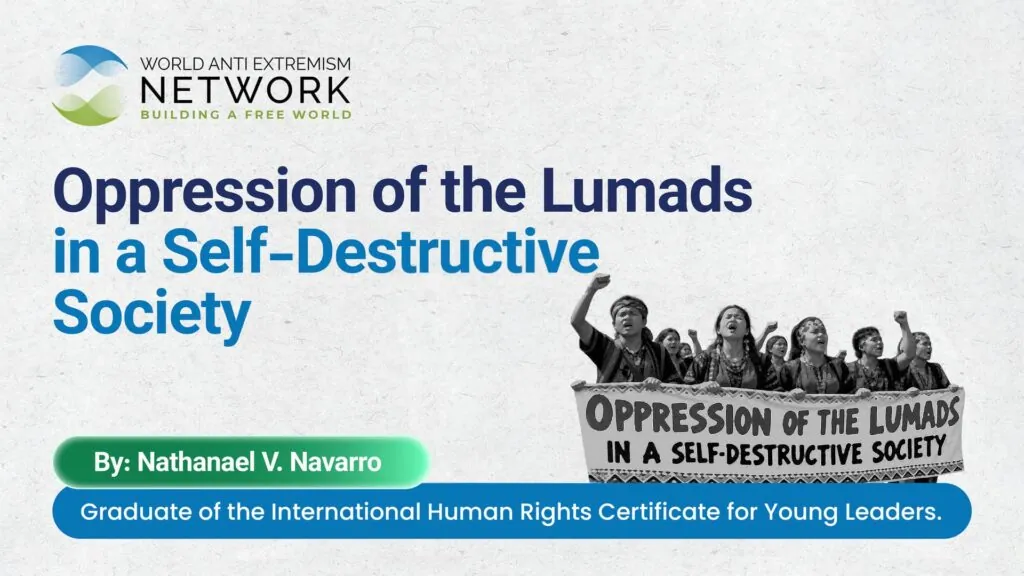
This essay argues that the oppression of the Lumads in the Philippines is closely linked to extractive economic development, environmental destruction, and the suppression of Indigenous voices. It examines how these practices undermine human rights, weaken democratic accountability, and threaten Indigenous communities’ livelihoods, cultural identities, and access to education.
SELF-DESTRUCTIVE SOCIETY
Despite all the incontrovertible indicators of climate change, it seems that the actions of most of us are expressive of pride and dismissiveness rather than fear and a sense of urgency. Our planet is torn by various forces of self-destruction. Due to wanton consumerism, excessively individualistic ambitions, and degenerative modes of production, the system has created planetary crises in its own midst. In some parts of the ancestral domains of the Lumads, the largest Indigenous group in the Philippines consisting of 18 non-Muslim and non-Christian ethnolinguistic groups, massive logging operations were legitimized by the Philippine government by granting Integrated Forest Management Agreement (IFMA) to private companies. According to Dante Sinhayan, a tribal leader in Bukidnon, many areas in their forestlands were denuded, depriving them of traditional resources that they use to build houses and even for food and medicine.
In fact, the climate crisis is only one repercussion of a world that reveres material wealth as the penultimate measure of development and success in life. With a geography and climate suitable to plant bananas, massive deforestation in Mindanao is caused by the expansion of plantations for the global market. Harmful chemicals in pesticides and insecticides also pollute the local ecosystem and pose direct health risks to farmers, many of whom are Indigenous peoples. Hospital surveys and studies conducted between 2006 and 2010 reveal a troubling rise in pesticide-related cases and mortality, showing farmers’ heightened vulnerability to exposure and its associated health effects, including headaches, skin abnormalities, fatigue, fever, and weakness. Furthermore, monoculture also causes soil nutrients to be depleted, as the soil normally needs a variety of plants to supply what has been extracted by other plants. Pest populations also increase because a lack of competition allows pests to invade and spread more easily. A telling example is the devastation of vast tracts of farms in Mindanao due to Fusarium, otherwise known as Panama disease. This agricultural devastation has been ruining the economy for approximately 15 years already. Monoculture intensifies Panama disease by heavily relying on genetically identical, tissue-cultured Cavendish bananas with limited natural resistance, while the fungus can remain in the soil for at least five years, which makes infected plantations vulnerable to extended losses.
MINING IN THE PHILIPPINES
The Philippines is the second largest producer of nickel in the world. However, abusive mining negatively impacts the environment and the lives of the people. In Palawan, nickel mining has contaminated seas and mountains, affecting the basic sustenance and livelihoods of many people without any compensation or even financial assistance. Mangrove and terrestrial forests are also being destroyed on a large scale for mining operations, affecting natural ways to mitigate floods and storm surges in some areas in Surigao del Sur and Dinagat Island. Mining operations also make rice farming difficult, as these areas are submerged and affected by massive siltation from denuded mountains. Although mining contributes less than 2% to the gross domestic product (GDP) of the Philippines, the Philippine Supreme Court defended the purported constitutionality of the Mining Act of 1995 in allowing foreign ownership of assets and exploration permits. The 1995 Mining Act lacks the democratic feature of being in close coordination and consultation with the affected communities, as the decision to grant mining permits rests on the authority of the President alone, upon the recommendation of the Department of Environment and Natural Resources (DENR) Secretary. In the process, affected people, especially the Indigenous communities, are marginalized from the decision, which allows abusive mining and exploratory operations for an extensive period of time with little benefit to the nation. The non-transparency in selling mining permits, along with numerous tax exemptions and privileges, is also protected by the 1995 Mining Act.
The Pantaron Range’s remaining forests are a lifeline for millions of Mindanaoans, sustaining essential ecosystem services while protecting the cultural identities and ways of life of Indigenous communities, including the Pulangiyen, Binukid, Obo Manobo, Ilianen Manobo, Ata Manobo, Higaonon, Tagabawa, Kalagan, Western Bukidnon Manobo, Giangan, Matigsalug Manobo, and Agusan Manobo. They also regulate water for 82 rivers and the needs of 42% of Mindanao, while serving as a vital refuge for biodiversity, including the critically endangered Philippine eagle (Pithecophaga jefferyi), Philippine brown deer, Philippine flying lemur, and Mindanao gymnure. Despite the immeasurable value of the Pantaron Range in Mindanao, many Indigenous peoples have been deeply affected in defending their environment from the excessively extractive mining operations approved by the government. The violent and displacement-inducing military activities were legitimized as measures to protect the “investment” interests of the country.
HUMAN RIGHTS VIOLATIONS
The confluence of gentrification, development aggression, neoliberal ideology, and authoritarian regimes has not only sidelined the voices of the environmental and human rights defenders but has resulted in violent suppression of dissent. According to the 2023 report of Global Witness, the Philippines has the highest toll of killings and forced disappearances against environmental defenders in Asia. Aside from the overt use of the state apparatus to inflict violence against environmental defenders, irresponsible consumerism also contributes to the perpetuation of human rights violations. Placed in the game of competition, the growing tourism in Palawan pushes businesses to commit massive illegal logging to attract many tourists, which makes the lives of environmental activists vulnerable to killings. The same gnarl of market competition pushed Del Monte Philippines to kill a defender of an Indigenous community in Mindanao whose lands were being encroached upon by wanton corporatization and extractive plantations. Furthermore, reducing environmental human rights violations to the criminal liability of individual perpetrators obscures the structural political economy that enables them, as is usually the case in Philippine jurisprudence, particularly how irresponsible consumerism, market competition, extractive industries, and state-corporate alliances can systematically produce violence against environmental and Indigenous defenders while making these conflicts appear as isolated criminal incidents rather than struggles over land, resources, and power.
Red-tagging activities have also been launched to accuse environmental defenders of supporting Communist rebels. This fabricated legitimization of suppression subjects Indigenous peoples to unfounded surveillance activities, legal quandaries, and harassment from state forces. According to the informants of a study conducted by the Klima Center of the Manila Observatory, gender-based violence is revealed as a deeply entrenched and obscured form of harm, where Lumad women and girls endure sexual abuse and coercion amid militarization, while fear, stigma, and weak access to justice allow these violations to remain largely unspoken, informally contained, and unpunished. Much like the subliminal support for state violence through mindless consumerism, climate disinformation operates as a political smokescreen, recasting Indigenous and environmental resistance as threats to so-called “progress” and “national security,” thereby manufacturing approval for red-tagging, repression, and violence in the name of so-called “development.” For instance, MacroAsia’s allegedly manufactured community consent through paid media claims that purported “Tribal Chieftains” represented 80% of Indigenous support for nickel mining, despite evidence that these representatives were hired for the project and that the colonial label itself is an externally imposed, derogatory term rather than an Indigenous nomenclature.
CURTAILMENT OF LUMADS’ EDUCATIONAL DEVELOPMENT
According to Arnold Alamon, the Lumads have endured successive waves of displacement – from Spanish colonial forces pushing them from riverbanks into the mountains, to American logging companies encroaching on their ancestral lands in the 1920s–1930s. Educational development of Lumad children is also stunted in an environment where violence reigns. Between 2016 and 2020, the Save Our Schools Network documented 1,030 cases of attacks and harassment, including fabricated accusations against Lumad teachers, alongside the shutdown of 215 Indigenous schools that disrupted the education of 5,579 Lumad students. In 2018, in the municipality of Talaingod, Davao del Norte, the intensified military operations and checkpoints, as well as the activities of paramilitary groups, drastically changed the lives of the citizens by subjecting them to a vicious cycle of intimidation and violence, which eventually forced the Indigenous peoples to evacuate from their communities. Even though the Philippines has been a signatory to the Geneva Conventions safeguarding International Humanitarian Law (IHL), humanitarian workers rescuing children from Salugpongan Ta’Tanu Igkanogon Community Learning Center Inc. (STTICLC) and the Community Technical College of Southeastern Mindanao (CTCSM) to take refuge from the Alamara paramilitary group were not only failed by the government to protect, but they were even subjected to legal challenges, accusing them of kidnapping and abusing children.
The Universal Declaration of Human Rights, proclaimed by the United Nations General Assembly in 1948, explicitly states in Article 27 that everyone has the right to participate freely in cultural life, enjoy the arts, benefit from scientific progress, and have their moral and material interests protected as creators of scientific, literary, or artistic works. The cultural life of people is important to protect because it gives communities the freedom to make their collective and individual lifeways meaningful and responsive to different contexts and life’s challenges. When taken from the value of other human rights, diverse cultural lifeways serve as profound motivational grounds to instill goodness and compassion in humanity. To abolish hostility and disrespect toward non-harmful worldviews, punishment must be meted out accordingly to curb spiteful treatment of cultures and to uproot cynicism. The deliberate destruction of the 1,500-year-old Buddhas of Bamiyan in Afghanistan and Mostar’s 427-year-old Stari Most during the Bosnian War illustrates how armed groups weaponize cultural heritage to instill fear, erode civilian morale, and erase collective identity. Grounded partly in Article 27 of the UDHR, the ICC’s 2016 conviction of Ahmad Al Faqi Al Mahdi for destroying historic and religious sites in Timbuktu established such attacks as prosecutable war crimes, offering a legal precedent for pursuing similar cultural destruction, including that perpetrated by ISIS in Iraq and Syria.
The archiving of the intangible collective heritage of the Lumads’ worldviews must also be done with a careful eye on the changes brought about by the cycles of violence and marginalization that they are facing, alongside the recognition of a dark reality that learning environments have greatly shifted and displaced the Indigenous peoples from their natural lands, where their education is deeply connected. Recognizing the importance of preserving Indigenous knowledge and cultural heritage, we need to engage in a dialogical approach to absorb the valuable lessons we can learn from traditional ecological practices – tendencies that move us away from greed-driven and egocentric economic relations. For example, traditional farmers practice a careful ecological reading of the landscape, choosing moderately sloped fields away from headwaters, preserving water-bearing trees to maintain groundwater and stabilize riverbanks, and using existing vegetation – such as lauan, olayan, and giyung – to determine which crops the soil can sustain. Rather than clearing indiscriminately, they also retain economically, ecologically, and medicinally valuable plants that provide nectar for honey production and fruit for wildlife, sustaining livelihoods while reducing pressure from wild animals on cultivated crops.
RECOMMENDATIONS
Addressing the oppression of the Lumads requires measures that protect Indigenous rights, strengthen accountability, and ensure that economic development does not come at the expense of human dignity and environmental well-being. The Philippine government should investigate attacks, threats, and red-tagging against Indigenous and environmental defenders and ensure that those responsible are held accountable through fair legal processes.
The protection of ancestral lands should also be strengthened through meaningful consultation with affected Indigenous communities before decisions concerning mining, logging, and plantation development are made. Environmental regulations must be effectively enforced, and companies found legally responsible for environmental damage should be required to meet their applicable remediation and compensation obligations.
Furthermore, Indigenous schools and humanitarian workers should be protected from intimidation and unjustified interference so that Lumad children can access safe, culturally appropriate education. Civil society organizations, educational institutions, and Indigenous communities should also be included in efforts to preserve traditional ecological knowledge and protect Indigenous cultural identity. These measures would help address both the immediate human rights violations and the structural conditions that allow them to persist.
CONCLUSION
Human rights and environmental well-being, as this essay shows, cannot be separated. The oppression of the Lumads demonstrates how extractive economic development, environmental destruction, and the suppression of dissent can undermine Indigenous peoples’ rights, livelihoods, cultural identities, and educational opportunities. Addressing these injustices requires democratic accountability, the protection of ancestral lands, and effective safeguards for Indigenous and environmental defenders. Governance, to be meaningfully democratic and attuned to authentic human flourishing, must also be responsive to and critical of the atrocities and self-destructive modes of the dominant economic regime. Minority worldviews and lifeways that are beneficial to collective well-being must be protected from a system that only kowtows to greed, which behooves us to engage in self-criticism to examine how we support destructive consumerism, however inconspicuous these may be. We can begin by criticizing our extravagant lifestyle, wasteful market choices, and even our ambitions that glorify excessive materialistic superiority. However, individual reflection must be accompanied by institutional action to ensure that governments, businesses, and other powerful actors are held accountable for violations of human rights and environmental protections. Indeed, we can protect human rights not only by vehemently protesting in the streets, but also by pausing and reflecting on how attentive we are to ecological development through the choices that we make. We have choices to make and a world to be reconceived toward a flourishing rooted in justice, dignity, and purpose.