

Introduction
A new academic year once symbolized hope and renewal for Afghan girls across Afghanistan. However, since the Taliban’s takeover in August 2021, this sense of opportunity has been replaced by exclusion and uncertainty as at least 1.4 million girls have been denied access to secondary education. Education is not only a means of acquiring knowledge but also a foundation for dignity, independence, and social participation. Depriving girls of this fundamental right limits their future opportunities and deepens gender inequality. In just three years, these policies have reversed nearly two decades of progress in girls’ education, putting the future of an entire generation at serious risk. Before the Taliban’s return to power, Afghanistan had made significant progress in expanding girls’ access to education. Between 2003 and 2018, girls’ secondary school attendance rose from 6% to 40%, and by 2020 nearly 40% of the country’s 10 million students were girls. Since the Taliban’s return to power, however, these achievements have rapidly deteriorated under increasingly restrictive policies targeting women and girls.
This essay argues that the Taliban’s ban on girls’ education constitutes a systematic violation of human rights and an authoritarian policy that threatens Afghanistan’s social, economic, and political future.
Educational Restrictions Under Taliban Rule
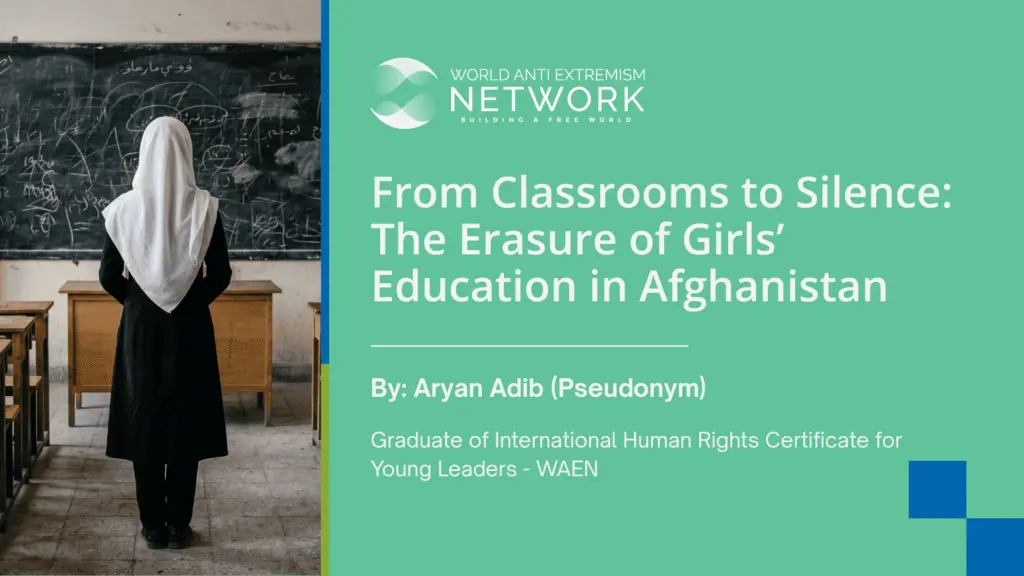
Since 2021, the de facto authorities have imposed a complete ban on girls’ secondary and higher education, preventing them from attending school beyond the sixth grade and barring them from universities. This policy has halted the academic progress of countless Afghan women, leaving them with no formal educational pathways. In addition, girls whose last option was to pursue their education overseas by applying for scholarships have been prohibited from doing so by the de facto authorities. A report shows that 60 students were not given permission at the airport to leave the country legally for educational purposes. Women are also restricted from travel unless accompanied by a husband, father, brother, or another male guardian (mahram). These policies not only limit women’s mobility but also isolate them from educational and professional opportunities beyond Afghanistan. Despite these restrictions, some underground schools continue to operate in defiance of the ban. However, these initiatives face serious risks, as teachers, students, and families fear punishment and take extensive precautions to avoid Taliban attention.
Social and Psychological Consequences of Educational Restrictions
The exclusion of girls from education has also contributed to a rise in early and forced marriages, as many families see no future for their daughters without education. At the same time, the denial of education has reduced women’s employment prospects and weakened their economic independence, increasing their reliance on male family members and reinforcing existing gender inequalities. The psychological consequences of these restrictions are equally severe. A recent study found that 87.6% of former female students who were banned from education reported symptoms of depression. Nearly half of the participants (49.8%) also reported suicidal thoughts following the restrictions. These findings demonstrate that the educational ban affects not only academic opportunities but also the psychological well-being, identity, and sense of purpose of Afghan girls. Another report has also revealed contradictions within the Taliban leadership itself, with some leaders’ daughters reportedly studying abroad in countries such as Qatar while millions of Afghan girls remain deprived of education within Afghanistan. Another alarming consequence of the restrictions is the growing loss of women in the workforce, particularly in education and healthcare, which further weakens an already fragile system. According to UNICEF, Afghanistan could lose up to 20,000 female teachers and 5,400 healthcare workers by 2030 if current policies continue.
Violations of International Human Rights and Islamic Principles
Afghanistan, under the control of the de facto authorities, is bound by customary international law and several signed human rights treaties, including the International Covenant on Civil and Political Rights (ICCPR) and the Convention on the Elimination of All Forms of Discrimination Against Women (CEDAW). According to Article 26 of the Universal Declaration of Human Rights, education is a fundamental human right that must be accessible to all individuals regardless of gender. Furthermore, the restrictions directly contradict Sustainable Development Goal 4 (SDG 4) of the United Nations, which emphasizes inclusive and equitable quality education for all. Hence, the current governing authority in Afghanistan violates the right to education for women in Afghanistan.Therefore, the Taliban’s educational restrictions represent a direct violation of internationally recognized human rights obligations and further isolate Afghanistan from the global community.
Many individuals with rigid and traditional viewpoints argue that restrictions on girls’ education are rooted in Islam, a narrative promoted by the de facto authorities. However, such anti-education policies conflict with the fundamental teachings of Islam, which encourage learning, justice, and the pursuit of knowledge. Taliban claims that girls’ education represents a foreign or Western concept are inconsistent with Islamic teachings. The first revelation to Prophet Muhammad (PBUH) began with the word “Read,” emphasizing the importance of knowledge in Islam. Additionally, the Prophet Muhammad (PBUH) stated that “Seeking knowledge is obligatory upon every Muslim” (Sunan Ibn Majah 224), reinforcing that access to education should not be restricted on the basis of gender.
Economic Consequences
The hardships faced by Afghan women extend beyond restrictions on education and include severe limitations on employment and participation in public life. A nation’s progress is closely connected to its education system, and by excluding women from schools and universities, Afghanistan risks long-term economic decline and social instability. Studies show that educated women contribute significantly to national development by reducing poverty, improving healthcare outcomes, and strengthening governance. In August 2022, UNICEF reported that excluding girls from secondary education reduces Afghanistan’s annual GDP by approximately 2.5%. The organization also estimated that if three million girls completed secondary education and entered the workforce, they could contribute approximately $5.4 billion to Afghanistan’s economy. Furthermore, the Afghan economy is projected to lose $9.6 billion by 2066 if women continue to be denied access to higher education. The decision to restrict girls above primary level from education has had devastating consequences in a country where approximately 85% of the population lives on less than one dollar a day. The exclusion of half the population from education not only deepens Afghanistan’s humanitarian crisis but also threatens the country’s future stability and development.
Resistance, Resilience, and International Response
Despite these restrictions, Afghan women and girls continue to resist. Underground schools and alternative learning initiatives have emerged to provide secret education opportunities for girls. Although many described the closure of educational opportunities for women as a devastating setback for human rights, Afghan girls continue to demonstrate resilience and determination. Even after further restrictions, including bans on women’s education in nursing and midwifery institutes, many Afghan women continue to advocate for their right to learn.
With every classroom denied to them, their determination to pursue knowledge continues to grow stronger. International organizations such as UNICEF and UNESCO are also working to support alternative learning initiatives and advocate for the restoration of girls’ education in Afghanistan.
Recommendations
Addressing the ban on girls’ education in Afghanistan requires coordinated action that moves beyond general statements and focuses on practical, rights-based interventions. Given the scale of the crisis, responses must engage both internal actors and the international community while prioritizing the protection of Afghan girls’ access to learning.
First, international organizations such as UNESCO and UNICEF should expand and formally recognize alternative education systems inside and outside Afghanistan, including community-based schools, remote learning platforms, and cross-border scholarship pathways. These mechanisms should be designed specifically for Afghan girls who are currently excluded from formal secondary and higher education systems.
Second, donor states and international financial institutions should link humanitarian assistance and development funding to measurable progress on girls’ education. While ensuring that humanitarian aid continues to reach vulnerable populations, targeted diplomatic pressure should be applied to prioritize the restoration of girls’ access to schooling at all levels.
Third, regional governments should facilitate safe educational mobility for Afghan girls by expanding scholarship quotas, simplifying visa procedures for students, and ensuring protection for Afghan female students studying abroad. This is particularly important given reported restrictions on female travel without a male guardian (mahram), which has directly limited educational access.
Fourth, stronger support should be directed toward underground and informal schools operating within Afghanistan. This includes discreet financial assistance, digital learning tools, and teacher training programs that can function under restrictive conditions while minimizing risk to students and educators.
Finally, sustained international advocacy is essential to challenge misinformation surrounding education and religious interpretation. Engagement with Islamic scholars, community leaders, and civil society actors should be prioritized to reinforce that education for girls is consistent with Islamic teachings and international human rights obligations, including those outlined in the Universal Declaration of Human Rights.
Conclusion
The ban on girls’ education in Afghanistan is a clear violation of international human rights and a major setback for the country’s social and economic development. As shown in this essay, it has reversed educational progress, increased poverty and early marriage risks, and weakened essential sectors such as health and education. Despite resistance efforts, including underground schooling, these cannot replace formal education systems. Under international frameworks such as the ICCPR, CEDAW, and SDG 4, the restoration of girls’ access to education remains a legal and moral obligation. Urgent coordinated action is therefore required to ensure Afghan girls regain their right to education and to prevent further long-term national decline.